Seaplane tours to be available in Viet Nam soon
Category Archives:Travel Information
Seaplane tours to be available in Viet Nam soon

The Thien Minh travel group has announced that it will offer seaplane tours this September, becoming the first supplier of this kind of tourism service in the country.
According to the group, Thien Minh, which owns Hai Au Aviation Company, will import two Cessna Grand Caravan EX aircraft from the US Cessna Aircraft Company.
The aircraft will arrive at Viet Nam’s Noi Bai International Airport in August before taking off for trial flights a month later.
They will initially operate on the Hanoi-Ha Long route, before expanding to other routes in the southern region, including routes between Ho Chi Minh City to Khanh Hoa, Binh Thuan, Can Tho, An Giang, Con Dao, and Phu Quoc.
According to Deputy General Director of Thien Minh Group and CEO at Hai Au Aviation Luong Hoai Nam, Viet Nam boasts favourable conditions to facilitate seaplane tourism services with many rivers and streams and a beautiful, long coastline.
Instead of spending 3-4 hours travelling by bus from Hanoi to Ha Long, it should only take tourists 30 minutes to travel by seaplane, while experiencing scenic beauty from a height of 150-3,000 metres, said Nam. “We believe that seaplane services will bring a new and comprehensive experience for tourists, while promoting the development of Viet Nam’s tourism in the future,” Nam added.
An expected cost of US$4,000, divided among the passengers, will be charged for a one-hour flight. A Hanoi-Ha Long one-way flight will cost around US$250 per person, while an extra US$100 will be charged for scenic flights around Ha Long Bay.
The state of the art US Cessna Grand Caravan EX seaplane can carry 12-18 passengers. It has a cruising speed of 300kph and is capable of taking off and landing at both normal airports and on the water.
Category Archives:Travel Information
Famous US chef explores Vietnamese cuisine, culture

Well-known American chef Robert Danhi will replace Martin Yan as the new host for the second season of a TV show “Kham Pha Viet Nam” (Taste of Viet Nam).
The information was released on June 10 by producers of the show, Dien Quan Media and Entertainment.
Robert Danhi, who is also a photographer, will take audiences on a tour of 19 provinces and cities in Viet Nam to explore culinary art, cultural identity and beautiful landscapes.
Under the theme “homeland’s sea and island”, the TV series will introduce the natural beauty of coastal areas in Hai Phong and Phu Yen, cave paradise in Quang Binh, Phu Quoc and Con Dao islands. The show will also promote destinations that are new or untouched by tourists.
The show, which is scheduled to air on HTV7 channel of HCM City TV Station at 21.00 every Friday from July 18, will help viewers follow chef Danhi’s footsteps to discover the landscapes, culture, people, and cuisine of different localities.
Robert Danhi is famous for his “Southeast Asian Flavours” book on adventures in cooking dishes of Thailand, Viet Nam, Malaysia, and Singapore. The book won the Best Asian Cookbook in the US in 2009, was awarded the second prize of the “Best Asian Cookbook in the World”.
He was invited to host the Taste of Viet Nam show late last year, making a big breakthrough in Danhi’s career.
Source: VOV
Category Archives:Travel Information
Ba Na named among 10 amazing cable cars worldwide
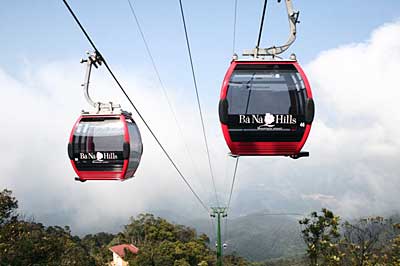
The Travel page of UK newspaper The Telegraph has named the Ba Na cable car on its list of ten amazing cable cars around the world.
The Ba Na site boasts the longest one-line cable car in the world (5,771 m), the largest difference in height between departure and destination (1,369 m), the longest non-stop cable (11,585 m), and the world’s heaviest cable rolls (141 tonnes).
In 2009, Ba Na Hills opened the first cable car route, setting two world records as the longest and highest non-stop cable car system.
The caption mentioned another cable car in planning that would connect the sleepy hill station of Sa Pa, in Viet Nam’s northwestern Lao Cai province, with the top of Mount Fansipan, Indochina’s tallest peak.
The other amazing cable cars include a cable car running to the 396 m peak of Sugarloaf Mountain in Rio de Janeiro, Brazil; The novel Cabrio cable car in Mount Stanserhorn, Switzerland; the Cape Town cable car in South Africa; the cable car in Merida, Venezuela; the world’s fastest cable car in Genting Highlands, Malaysia; Europe’s highest cable car in the Klein Matterhorn mountain, Switzerland; the four-passenger gondola from Banff to the summit of Sulphur Mountain in Canada; the Ngong Ping Cable Car in Hong Kong; and the Skyline Queenstown cable car in New Zealand.
Source: Vietnamtourism
Category Archives:Travel Information
Hue Attractions
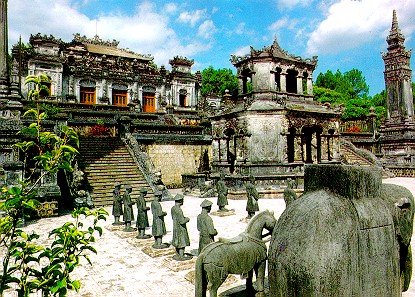
Hue is well known for its historic monuments, which have earned it a place in UNESCO’s World Heritage Sites. The seat of the Nguyễn emperors was the Citadel, which occupies a large, walled area on the north side of the Perfume River. Inside the citadel was a forbidden city where only the emperors, concubines, and those close enough to them were granted access; the punishment for trespassing was death. Today, little of the forbidden city remains, though reconstruction efforts are in progress to maintain it as a historic tourist attraction.
Roughly along the Perfume River from Huế lie myriad other monuments, including the tombs of several emperors, including Minh Mạng, Khải Định, and Tự Đức. Also notable is the Thiên Mụ Pagoda, the largest pagoda in Huế and the official symbol of the city.
A number of French-style buildings lie along the south bank of the Perfume River. Among them are Quốc Học High School, the oldest high school in Vietnam, and Hai Ba Trung High School.
The Hue Museum of Royal Fine Arts on 3 Le Truc Street also maintains a collection of various artifacts from the city.
The Citadel
The citadel in Hue is a complex monument which was built in between the 19th to 20th century in the Old Royal Hue area that is belonged to Hue City and some parts of Thua Thien – Hue Province nowadays. This complex is divided by two parts, inside and outside the Citadel.
Inside the Citadel, there are houses of people and mandarins but the most important is the “ Hoang Thanh” area where Nguyen Emperors and their Royal families were living and working. According to historical source, it started to build in 1804 but accomplished on 1933 under the Minh Mang Emperor. Hoang Thanh has 4 gates at 4 directions and the main gate is in the South which called Ngo Mon. Inside Hoang Thanh, there is Thai Hoa Temple where the Kings met their officials, the altars area, and the Forbidden City that was place for Kings and their families living. People were not allowed to come into this area.
There are many other relics in and outside the Citadel.
Minh Mang Tomb
Minh Mang Tomb was built by Thieu Tri King in 1840 – 1843 which needed 10,000 workers and soldiers. It located in Cam Ke mountain and that place is the confluence of the left and right tributary that creates the romantic Huong River, around 12km from Hue city.
Minh Mang was the second King of Nguyen Dynasty and replaced for his father Gia Long King on 1920. In 1940, Minh Mang King was chosen that place for his tomb and started to build but he was died on 1841 while this project just was in the first step . His son, Thieu Tri King continued to follow that work for his father so this tomb also named as “ Hieu Lang”. “ Hieu” is filial.
Khai Dinh Tomb
Khai Dinh was in the throne at the age 31th, 1916. Right after became a King, Khai Dinh was constructed many places, temple for himself and his royal family such as Kien Trung Temple, An Dinh, Truong An gate , Hien Nhon gate, Chuong Duc gate but the special one is Ung Lang ( Khai Dinh Tomb) This temple located in Chau Chu mountain. Khai Dinh King was chosen this place as there is a low hill in front , Chop Vung and Kim Son mountain on the left and right hand side and a stream from Chau E for good “ Feng shui” .
This construction was took in 11 years . Compared with other tomb, Khai Dinh tomb has a smaller surface but that was very gaudy in construction. For building it, Khai Dinh was sent his people to French for buying iron, steel, cement, tiles from Ardoise… He was sent the boats to China and Japan to buy ceramics and colorful glasses for decoration.
Tu Duc Tomb
Tu Duc Temple is a complex of architecture that also is the place of Tu Duc tomb. It located in a small valley at Duong Xuan Thuong village and now that is Huong Ba Village, Thuy Xuan Commune, Hue City. That is a beautiful place and this Temple is one of the most beautiful temples of Nguyens Emperor. This construction was a reason of a rebel at that time as people was suffer at the hard work and under the rude treatment.
There are around 50 units of construction in the Temple and Tomb areas including the worship area, the relaxing place …. The roads were made by Bat Trang bricks ( that ceramic village still exist and very well known in Ha Noi). Tu Duc used Luu Khiem Lake as a place for drawing, reading, writing poems… In front of the lake, there are the three bridges that lead to the pine hill.
Thien Mu Pagoda
Located beside the picturesque Huong River, Thien Mu Pagoda, with its ancient architecture, adds its charm to this beautiful natural setting. The sound of Thien Mu bell is like the soul of Hue, ever resounding over the Huong River flow winding its way in front of the Citadel to the sea, resonating in the hearts and minds of the people and of visitors to Hue, the ancient capital.
Phuoc Duyen Tower is a famous symbolic link with Thien Mu Pagoda. It is 21 metres high, has seven storeys, is located in front of the pagoda and is visible from the Huong River. On each of the seven storeys there is a statue of Buddha. Inside the tower a spiral staircase leads to the top storey where formerly a gold Buddha statue was displayed. Huong Nguyen temple is in front of the Tower.
The Pagoda is surrounded with a garden of flowers and plants that are carefully tended every day. There is a bonsai of the ancestor of Vietnam Tuong (Classical drama), Dao Tan, situated next to the car left in 1963 by the Superior Buddhist monk, Thich Quang Duc, before burning himself to protest the policy of Ngo Dinh Diem regime in suppressing Buddhism. At the end of the garden is the Tower of the Superior Buddhist monk Thich Don Hau, a famous head of Thien Mu Pagoda who devoted his whole life to the promotion of Buddhism and the good of society.
Huong River
Huong River ( Perfume River) is the river that crosses the City of Hue. That is one of the feature of Hue as its romantic scenery along the river.
The Perfume River has two sources, both of which begin in the Trường Sơn mountain range and meet at Bang Lang Fork. The left tributary originates in the Truong Dong mountain range and flows northwest towards Bang Lang Fork. The shorter right tributary flows past the Tuan ferry landing towards Bang Lang Fork.
Tourist often takes a boat trip on Huong River from the port at the center to visit Minh Mang Tomb, Hon Chen Temple or Thien Mu Pagoda. In the evening, tourist can enjoy the Hue traditional music show on the boat.
Quoc Hoc Hue
Quoc Hoc is a famous school in Hue, the old capital. Established under the reign of Thanh Thai King 1986, Quoc Hoc was named Ecole Primaire Superieur but also called Quoc Hoc , Khai Dinh High School ( 1936-1954), Ngo Dinh Diem High School ( 1955 -1956 then Quoc Hoc since 1956 until now.
Some of famous persons who became leader in Viet Nam were studied in this school including Nguyen Sinh Cung ( Ho Chi Minh), President of Democratic Republic of Viet Nam.
Bach Ma National Park
Bach Ma National Park is located in the provinces of Thua Thien Hue and Quang Nam. The park covers an area of about 37,487 ha in Phu Loc district. It was first protected as a series of forest reserves in 1937, and was declared a protected area by the government of South Vietnam in 1962. In 1986 the area was established as a national park. The forests of the park, like Cat Tien National Park, suffered from the use of defoliants like Agent Orange during the Vietnam War.
Bach Ma National Park has six guesthouses. Two guesthouses, provide ten rooms, are close to the park’s entrance and four guesthouses ( Bach Ma, Saola, Do Quyen and Kim Giao ) with the total capacity of 26 rooms were reconstructed near the summit at an attitude of 1250m above the sea level.
Lang Co beach
Lang Co Beach is a beautiful landscape of Thua Thien – Hue Province. Along with Hai Van and Non Nuoc, it was listed as a tourist attraction site in Viet Nam.
Lang Co beach is well known with its natural beauty, the 10km long white sand beach, surrounding with the large tropical forest and Truong Son mountain range, on the line Hue – Da Nang, 30 km from Da Nang to the North and 70km from Hue the South. Almost of tourists and passengers would love to take a break at Lang Co for its beauty and fresh seafood.
Predicted the tourist’s demand, there are some 4* Resorts were built as Lang Co Beach Resort, Nirvana Resort and Spa and the newest and most luxury one is Nevada Lagoon Resort and Spa 5*.
Category Archives:Travel Information
Da Nang Attraction
Da Nang was the landing point of both the French and the Americans during their stints in Vietnam. When the French established a garrison in Da Nang (then called Tourane), more soldiers died from disease than the associated fighting in establishing the garrison. There is now a small cemetery dedicated to them.
During the Vietnam War, Da Nang was the home to one fifth of all US servicemen based in Vietnam. This made Da Nang on of the heaviest defended cities in South Vietnam, yet it eventually fell to the North Vietnamese in 1975 with hardly a bullet fired.
Son TraDa Nang marks the halfway point between Hanoi and Ho Chi Minh City and was the first place to organize its own local communist party committee. The city is fairly featureless, and if you are coming from the tranquil setting of Lang Co, Hoi An, or anywhere for that matter, Da Nang is an extreme disappointment. It is a busy, dusty, colorless city, the fourth largest in Vietnam, and one of the largest business centers. Unless you are in Da Nang for business, chances are you will pass straight through. Da Nang does have a fascinating Cham Museum that contains an excellent collection of Cham art. However, the main reason for staying in Da Nang is in the surrounding region. Non Nuoc Beach, the Marble Mountains, Hoi An and My Son are all within striking distance of Da Nang, though it is more pleasant to stay in Hoi An and visit these sights.
Currently, Da Nang is among the most visited tourism sites in Vietnam that attracts many tourists who opt for Vietnam tours and enjoy Vietnam holiday
Lang Co Beach
Lang_co_beachIf you are not planning on staying in Lang Co, if you do get a chance to visit the area, you most likely will change your mind. The main street is lined with palm trees and the ocean is just wonderful for swimming. Crystal clear waters lap onto fine white sandy beaches. Lang Co is on a sand peninsula with a sparkling lagoon on one side, and a long beach lining the East Sea on the other. This is one of the most beautiful places in Vietnam, and is yet to be developed extensively for tourists, which is probably a good thing.
Hai Van Pass
Imperial cityTraveling by road between Lang Co and Da Nang, you will have to drive over the Hai Van Pass. This pass is created by a spur from the Truong Son Mountain Range that extends to the coast. The views as you go up and through the pass are sensational. Of course, because of the demands of this extremely mountainous road does cause many of the local vehicles to break down. So if you are going with a local vehicle, allow yourself plenty of time. The view from the top of the pass is extraordinary and well worth it.
Should you be traveling by train, the train passes through tunnels at the base of the mountain as well as along the shoreline, so you will miss the spectacular views from the mountain top. However you will nonetheless see some awesome scenery.
Cham Museum
Cham MuseumThe Cham Museum is the main attraction of Da Nang and is worth the trip, even if it is from Hoi An. This old sandstone building houses an excellent collection of Cham art and sculpture. The museum was built between 1915 and 1916, with Da Nang being chosen due to its proximity to the themes of Cham architecture, and was enlarged in 1936 as the collection of works increased. There are now over 300 pieces of sculpture and they are all original pieces of work. The sculptures are located in ten different rooms which are individually named for the name of the district in which the relics were found.
Non Nuoc Beach
Non Nuoc BeachNon Nuoc Beach extends north and south of the Marble Mountains and was made famous by the war and a subsequent TV series bearing its name. Non Nuoc Beach is within cycling distance of Da Nang and due to this close proximity it was used as an R&R destination for American soldiers during the war. It is a long beach that stretches all the way down to Cua Dai beach at Hoi An. The distinction that makes Non Nuoc Beach popular is its high surf. Non Nuoc Beach actually hosted Vietnam’s first International Surfing Competition in 1992.
My Khe Beach
My Khe beachMy Khe is the beach directly east of Da Nang on the East Sea. It is about 6 km from the centre of town. To get there, you must cross the Han River via the Nguyen Van Troi Bridge. Turn left after the river crossing onto the main road, then a right after a couple of kilometers, and follow this street until you reach the beach. My Khe Beach and Non Nuoc Beach are only 65 km apart and they are connected by the same stretch of coastline of uninterrupted sand. This proximity to each other makes it easy to understand why there is a certain confusion as to which is the real ‘Non Nuoc Beach’, as it is essentially the same beach. In fact, there are some who argue that the 1992 International Surfing Competition actually took place at My Khe Beach!.
Marble Mountains
Marble MountainsThe Marble Mountains are made up of five limestone outcrops in isolation from the surrounding plains. Each of the mountains is riddled with caves and grottoes, with some made into pagodas and shrines. Each mountain represents one of the five elements of the universe; water, wood, fire, metal and earth. The principal or larger mountain represents water and has a path to the top with two entrances available to tourists. The main entrance is at the front while the second entrance situate on the reverse side, farther down the road, provides a much less strenuous climb. The mountain top offers spectacular views of Da Nang and the other surrounding Marble Mountains. There is even a better vantage point which can be reached by going through a small opening at the top of one of the caves. Here you will also be able to see Non Nuoc Beach and Cham island.
As you start climbing the stairs that lead to the top of the mountain, you will be approached by young children offering to guide you or sell you stone carvings. The young guides are very good and very knowledgeable. All they usually want as payment is for you to buy a small stone carving, which will also serve as a great souvenir for yourself or someone back home. Some of the larger caves have been transformed for religious purposes. Statues of Buddha have been built in most of these caves along with statues of all the associated guardians. Some of these caves are quite eerie with the smell of incense floating in the air. One thing that you will notice on the walls are the large number of bullet marks made from fighting which took place during the Vietnam War. During the Vietnam war there was some heavy fighting in this area. Troops fought in violent cave to cave battles.
Marble MountainsIn Huyen Khong cave, one of the large holes in the ceiling was caused by a bomb. In this cave, there are a number of shrines, temple guards and Buddha statues. There are still stalactites on the ceiling. Off to one side of the cave there are two small stalactites that are believed to represent breasts, one is dripping whilst the other is dry. According to legend, when Emperor Tu Duc entered and touched one of the stalactites, it stopped dripping forever.
At the base of Marble Mountains there are a large number of stone carving shops reminiscent of Mahalliburipuram, India. As you approach these shops, you can hear the endless chipping away of stone. All these stores are very keen to sell you a three foot high temple dog.