10 Must-See Attractions in Hanoi
Category Archives:Travel Information
10 Must-See Attractions in Hanoi
Vietnam’s desirability as a tourism destination seems to escalate every year, to the point where the country has almost become mainstream in appeal. What a phenomenal transformation for a country that was once a poor backwater, ravaged by civil and foreign wars, colonial incursions and endless regional strife. Underneath it all however, Vietnam has always been a jewel. Mass emigration abroad over the course of the last half century, to Australia, Canada, the United States, France and other nations, has had one major beneficial side effect that has come to the fore in recent years. Demographic assimilation diffuses cultural appreciation and curiosity and as a result, a Vietnam at peace and relative prosperity welcomes more tourists than ever.
From coastal resort towns to small village charm, the 13th most populous nation on the planet has a lot to offer. The gem of Vietnam however, may be the capital city of Hanoi. Busy, with a metro population of more than 6 million people, frenetic Hanoi has a host of highlights to take in. Here are 10 must-see attractions in the city that will mark 1,000 years of foundation in October 2010.
10. Temple of Literature
A tribute to Confucius and the site of the first university in Vietnam, the beautiful Temple of Literature has been around since the year 1070. The landmark contains numerous courtyards and pavilions, many of which have undergone careful restoration in recent decades.
9. Grand Opera House
A dramatic memory of French influence in Vietnam, the Grand Opera House in Hanoi is a typical and exquisite piece of colonial architecture. Built between 1901 and 1911, the opera house is a replica of the Palais Garnier in Paris.
8. Ho Chi Minh Mausoleum
One of the most conspicuous mausoleums in the world, the massive tribute to the most famous leader in Vietnam provides Hanoi with a landmark on par with Lenin’s tomb in Moscow. Open since 1975, the mausoleum site also contains a museum on Ho Chi Minh.
7. One Pillar Pagoda
The Buddhist One Pillar Pagoda is almost peerless in Vietnam, with a history that dates back a full millenium. The iconic landmark was badly defaced by French troops in 1954 but was rebuilt decades later.
6. Hoan Kiem Lake
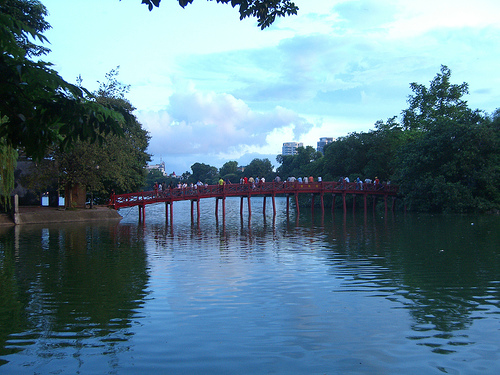
Hanoi is a city of lakes and Hoan Kiem is one of the most popular with visitors. Superbly scenic and serene, the lake provides a habitat for soft-shell turtles and contains many picturesque pagodas and small bridges.
5. The Presidential Palace
Although Ho Chi Minh obstinately refused to stay there, the Presidential Palace in Hanoi is a remarkable landmark. Built by the French at the turn of the last century in Italian Renaissance style, the palace serves as a government house today. Visitors can walk the grounds for a small price.
4. National Museum of Fine Arts
For a singular glimpse into Vietnamese culture, the country’s National Museum of Fine Arts is the best place to visit. The facility contains a vast collection of art, sculpture, crafts and artifacts from every period in Vietnam’s history.
3. Hanoi Hilton
Synonymous with prisoners of war, the Hanoi Hilton is a colloquial term for a notorious facility first used by the French, then by the North Vietnamese, to hold and torture captives. American POWs at the height of the Vietnam War gave rise to the name, with John McCain as one notable long-time prisoner. Today a part of the Hanoi Hilton serves as a museum.
2. West Lake
West Lake is first in size in Hanoi and is extremely popular with locals and visitors alike. Pagodas, restaurants and hotels line the body of water and serve as lively focal points.
1. Tran Quoc
The most historic pagoda in all of Hanoi, Tran Quoc is the foremost symbol of Buddhism in the country. The landmark’s origins date back some 1,500 years, although over time it has undergone changes in appearance and location.
Category Archives:Travel Information
Ho Chi Minh City Attractions

There are plenty Ho Chi Minh City attractions to keep you busy for at least a couple of days. Most are centrally located so you can travel between them on foot although the cyclo drivers will be keenly waiting at every corner to offer their services.
Cheap Transport in Ho Chi Minh City is readily available by cyclo, on the back of a motorbike (not recommended for safety reasons) or by metred taxi.
Below are the main Ho Chi Minh City sights with a brief explanation and opening times. They are listed in the order in which we visited them.
Hotel de Ville
This French colonial building is now home to the local Ho Chi Minh People’s Committee. It is closed to the public but is a good place from where to begin your HCMC sightseeing tour.
Museum of Ho Chi Minh City (Opening Hours: Daily 8am-4pm)
Just a few minutes walk from the starting point at the Hotel de Ville is this city museum which has displays depicting the communist power struggle in Vietnam throughout history.
War Remnants Museum – 28 Vo Van Tan St, (Opening Hours: Daily 7:30-11:45 & 1:30-5:15)
This museum was formerly known as the Museum of Chinese and American War Crimes. It tells the story of the Vietnam/American war through hundreds photographs, some of them quite horrific. Not recommended for children.
Reunification Palace 106 Ð Nguyen Du District 1, (Opening Hours: 7:30am-11:00am & 1:00pm-4:00pm)
Probably the most important building in HCMC in terms of recent history the Reunification Palace was the HQ of the South Vietnamese during the War. The two tanks to your right as you look directly at the Palace were the very ones that knocked down the gates you look through which marked the Fall of Saigon on April 30, 1975 and the official handover of power. You can go inside and have an interesting tour of the premises with a guide who will take you into the Presidential rooms and will show you the rooms in the basement from where the War was run by the Americans and South Vietnamese.
HCMC Post Office & Notre Dame Cathedral – D.Han Thuyen
The Post Office is a French colonial building dating back to the 1890s with Uncle Ho looking down on you as you buy your stamps. Just opposite the entrance is the Notre Dame Cathedral with its 40m high towers, two sharp reminders of the French influence on this city. There is a mass at 9.30am on Sundays which is the best one for tourists to attend.
History Museum & Zoo – 2 Nguyen Binh Khiem, (Opening Hours: Mon.-Sat. 8-11:30 and 1:30-4:30)
The city’s most educational museum devoid of propaganda which shows 4000 years of Vietnamese history in which the War plays just a small part. It is housed in a magnificent Sino-French style building and lies just inside the gate to the city zoo. and botanical gardens.
Jade Emperor Pagoda – 73 Mai Thi Luu St, (Opening Hours: Daily 7-6)
This is the finest pagoda in HCMC. Getting there is a bit of a hike along busy roads so you might want to take transport there. On the other hand if you’re planning on visiting Cholon you could give this one a miss and go to some of the extraordinary living pagodas in the Chinese quarter.
End of Day 1 Sightseeing … Upto here was a full day of sightseeing with a lunchbreak and rest included (jetlag was still a problem). The following day we headed out to the Chinese District of Cholon and visited a couple of markets. Read on ….
Chinese District of Cholon – District 5
Cholon is HCMC’s Chinatown which lies some 5km west of the central tourist area so you’ll need some transport to get there.
We took a taxi which dropped us off at Phuoc An Hoi Quan Pagoda then we walked the streets of Cholon visiting various other pagodas which were packed with people carrying out their prayer rituals. This area is fascinating with few tourists in sight.
The roads are packed with motorbikes and the pavements with street sellers offering everything imaginable. You need to allow a few hours to wander these streets and end at Binh Tay Market before taking transport back to the central area.
Ben Thanh Market, (Opening Hours: Daily 7am-7pm)
If you only go to one market in HCMC make sure it’s this one which is the most centrally located. This huge indoor market sells everything you can imagine. Of most interest to many visitors is the selection of quality branded goods and the food area which is well worth a few photos even if you’re not buying anything. Who knows what some of those fruits are! If you’re there at lunchtime go for noodles at Pho 2000 which is famous as the place where Bill Clinton ate noodles on his visit to HCMC in 2000 when he was the first US President to visit Vietnam.
Category Archives:Travel Information
Ho Chi Minh City
Ho Chi Minh Overview:
Ho Chi Minh City formerly named Saigon is a largest City in Viet Nam located in the Southern. It was renamed to Ho Chi Minh City in 1975.
However, the informal name of Saigon remains in daily speech both domestically and internationally. Saigon nowadays is on strong developing with many international commercial buildings and many industrial Zones around the outskirt areas.
There are 12 districts from number 1 to 12 inside the city and 11 districts in outskirt area they are Tân Bình, Bình Thạnh, Phú Nhuận, Thủ Đức, Gò Vấp, Bình Tân, Tân Phú, Nhà Bè, Cần Giờ, Hóc Môn, Củ Chi, Bình Chánh.
Ho Chi Minh City is the most crowded city in Viet Nam with the estimated population around 10 million in this present time. A big part of them is from other cities and provinces throughout the country specially from the North.
There are millions of motorbikes in this city due to the population density.
Ho Chi Minh geography:
Ho Chi Minh City located in the southeastern region of Viet Nam, around 1750 km from the South from Ha Noi Capital.
The average elevation is 19 metres above sea level. It borders Tay Ninh and Binh Duong provinces to the north, Dong Nai and Ba Ria-Vung Tau provinces to the east, Long An Province to the west and the South China Sea to the south with a coast 15 km long. The city covers an area of 2,095 km2
Transports:
– By Air: – Tan Son Nhat International Airport: Ho Chi Minh City is served by Tan Son Nhat International Airport, located in Tan Binh District. Tan Son Nhat Airport is currently the largest airport in Vietnam in terms of passengers handled (with an estimated number of over 15.5 million passengers per year in 2010, accounting for more than half of Vietnam’s air passenger traffic ; it will soon be superseded by Long Thanh International Airport, scheduled to begin operation in 2025. Based in Long Thanh, Dong Nai Province, about 40 km northeast of Ho Chi Minh City, Long Thanh Airport will serve international flights, with a maximum traffic capacity of 100 million passengers per year when fully completed;[35] Tan Son Nhat Airport will serve domestic flights.
– By Rail: – Ho Chi Minh City is also a terminal for many Vietnam Railways train routes in the country.
The Reunification Express (tàu Thống Nhất) runs from Ho Chi Minh City to Hanoi from Saigon Railway Station in District 3, with stops at cities and provinces along the line.
– By Water: – The city’s location on the Saigon River makes it a bustling commercial and passenger port; besides a constant stream of cargo ships, passenger boats operate regularly between Ho Chi Minh City and various destinations in Southern Vietnam and Cambodia, including Vung Tau, Can Tho and the Mekong Delta, and Phnom Penh. Traffic between Ho Chi Minh City and Vietnam’s southern provinces has steadily increased over the years; the Doi and Te Canals, the main routes to the Mekong Delta, receive 100,000 waterway vehicles every year, representing around 13 million tons of cargo. A project to dredge these routes has been approved to facilitate transport, to be implemented in 2011–2014.
Category Archives:Travel Information
Street Food in Lò Đúc, Hà Nội City
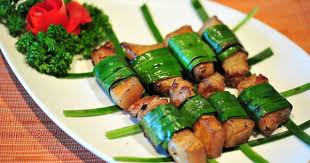
Lò Đúc (located in Hà Nội City) is a famous place to the local teenagers who are seeking for amazing Vietnamese Street Food with reasonable price, the food here is calling everyone through its signature smelling especially at night.
If you go there with only 1 partner, then it should only cost you 200,000 VND at most to eat to satiety. People in Lò Đúc are specialised in grilled Vietnamese Street Food and normally from August to December, the street is full of guests because of cold weather which makes the food is even better.
Even though it is known that using stove with alcohol is more convenient, less smoky and less harmful, the local people still believe that only using coal stove and grill manually would make the best quality food.
A small kiosk in Lò Đúc (near Trần Xuân Soạn, Hà Nội) has been there for quite a long time but never show that it lost its reputation. There might be fewer customers coming to the kiosk when the weather is hot, but the rest of the time customers are lining up to buy food here.
Street Food in Lò Đúc, Hà Nội City
1. Grilled Pork Side (Thịt ba chỉ nướng)
This dish is one of the typical Vietnamese Street Food, each piece of meat is carefully selected, contain both the lean and fat. We slice the meat, marinate in spices then grill in a hot coal stove. Be careful when grilling, you must remember to turn the meat side constantly until it is cooked. For 2-3 people, depending on how much you can consume, you can order 3-4 plates with a total price (drinks included) within 200,000 VND.
2. Grilled Rolled Beef (Bò cuộn)
This delicious dish is recently introduced by the owner. The first time tasting you might wonder why the beef is crunchy and different from the original grilled rolled beef. The secret is that the vegetable inside the roll and in the middle there are corncobs.
3. Crunchy (Giòn lai rai)
For others, the reason they come here is because of the dish named Crunchy (Giòn lai rai). The dish name is created by the customers. Its main ingredient is the pig or cow’s heart stems marinated with spices.
4. Honey Bread (Bánh mì mật ong)
In the menu, there are 13 grilled Vietnamese Street Food, such as grilled beef, spicy marinated oyster, grilled octopus with pepper, grilled pork side with sour and sweet sauce, etc. Accompanying with these dished is Honey Bread (Bánh mì mật ong) which will definitely make you remember the taste forever.
The only inconvenient thing when eating these grilled Vietnamese Street Food is that your clothes may be smelly for quite a time. However, for the food lovers, being able to enjoy these grilled food, that little “inconvenient” thing is not worth time for second consideration.
Category Archives:Travel Information
Hanoi City
Ha Noi Overview:
Ha Noi City is a capital and locates at the North of Viet Nam. This is a largest city about nature square meter and the second biggest city after Saigon. This is the most important political center and also is the second city with high population density in Viet Nam, 6,5 million in 2009.
Since 2008, Ha Noi has 3344,7 km2 square meter including one town, 10 districts and 18 outskirt districts. Ha Noi is on fast development with the new and comfortable infrastructure system in the urban areas. Many modern buildings were built up due to the developed economy.
Ha Noi is one of the main tourist attraction in Viet Nam as its famous heritage site Ha Long Bay; the beautiful North-West as Sapa, Bac Ha; history site as Dien Bien Phu…
History:
Hanoi City has been inhabited since at least 3000 BC. One of the first known permanent settlements is the Co Loa citadel founded around 200 BC.
Ha Noi has had many names throughout the history since under the domination of Chinese and French occupation.
In 1831, Minh Mang King named it “ Ha Noi”. Ha Noi became the capital of Viet Nam after the reunification on July 2, 1076.
Geography:
Hanoi is located in the Red River Delta, in the center of North Vietnam. It is encompassed by Thai Nguyen, Vinh Phuc provinces to the north, Hoa Binh and Ha Nam to the south, Bac Giang, Bac Ninh and Hung Yen provinces to the east, Hoa Binh and Phu Tho to the west.
Hanoi means “the hinterland between the rivers” (Ha: river, Noi: interior). Hanoi’s territory is washed by the Red River (the portion of the Red River embracing Hanoi is approximately 40km long) and its tributaries, but there are some other rivers flowing through the capital, including Duong, Cau, Ca Lo, Day, Nhue, Tich, To Lich and Kim Nguu. (Source: vietnamtourism.com)
Transportation:
As other big city, the transfer in Ha Noi City is quite convenient with many kinds of vehicle as taxi, public bus, Honda “om” ( motorbike) , pedicab.
We are strongly advised you to get a taxi for more comfortable and safety.