King Air 350C expands Gama’s fleet
Category Archives:Aviation News
King Air 350C expands Gama’s fleet

Gama Aviation, the global business aviation company, has expanded its charter fleet offering with the addition of a multi-role Beechcraft King Air 350C The King Air 350C, is being offered by Gama Aviation for both utility and corporate use. It will be available in one of four optional configurations; Executive, Commuter, Cargo and Medevac.
The latest addition to the Gama Aviation fleet will be based at the company’s landmark Glasgow Airport facility, which formally opened in November 2013. The aircraft is also expected to run regular charters to Europe out of Gama Aviation’s Farnborough Airport HQ. Paul Cremer, Commercial Manager, for Gama Aviation says: “We have received considerable interest for the aircraft in its cargo configuration as currently there is restricted access to aircraft of this size for cargo and freight missions. We expect it to be very popular with existing clients as well as encouraging a new client base to work with us.” Owing to its intelligent design a medevac configuration is also quickly achievable and can be ready with in a short time of a request. Cremer adds “The double Lifeport facility in the Medevac configuration provides yet another option for this flexible platform.” In its Executive and Commuter formats Cremer anticipates the aircraft will be in high demand from travellers seeking easy access to the more remote parts of Scotland, for example, for either business or pleasure. With a range of up to 1,400nm it also provides a cost-efficient transport mode for European charters only requiring a 1000 metre runway.
The aircraft joins a varied UK fleet which include types such as theChallenger 604, Learjet 45, a Gulfstream G550, and a Hawker 1000. Cremer adds, “Our mixed fleet means we can fulfill a variety of clients’ mission requests. However, the addition of such a versatile aircraft brings an extra dimension to our offering and with the multi-use options we expect it to be popular across a number of sectors.”
Gama Aviation already operates King Air aircraft on behalf of the Scottish Ambulance Service and this latest addition can also serve as an ad-hoc additional aircraft to support this or other emergency requirements.
As a Beechcraft Authorised Service Centre providing maintenance for King Air, Baron and Bonanza aircraft, Gama Aviation will benefit from being able to maintain its own aircraft through its engineering and maintenance division. Paul Bristow, Engineering Director for Gama Aviation adds: “We have been involved with the King Air range of aircraft over the last 30 years so it is fitting that we now have this aircraft type added to our fleet. We are all looking forward to the potential this aircraft brings to the business.”
Source and image: Gama Aviation
Category Archives:Aviation News
NATA Safety 1st Launches Resources for Aircraft Operators

Adding to its array of industry-leading safety programs, the National Air Transportation Association’s Safety 1st Program announces the launch of RA Check and Self-Fueling & Ramp Safety Training. NATA Safety 1st is the standard for safety and operational training for FBOs and line service and is pleased to extend these groundbreaking programs directly to aircraft operators.
RA Check fulfills a vital role in safety management programs with an innovative combination of the most up-to-date safety risk assessment methods and convenient automation features. Compatible with most smartphones, RA Check is based upon the FAA Flight Risk Assessment Tool (FRAT), includes automated weather updates from NOAA and ADDS and is fully compatible with CTA FOS.
The new Self-Fueling & Ramp Safety training program provides basic fuel handling, refueling and safety training in an online format for aircraft operator employees that service aircraft. This training is based upon industry-leading content currently delivered online through NATA’s renowned Safety 1st Professional Line Service Training Program (PLST).
“We are very excited to expand NATA’s Safety 1st program with the launch of these exciting newly integrated programs featuring RA Check and the Self-Fueling & Ramp Safety,” said NATA President and CEO Thomas L. Hendricks. “Our mission is to empower our members to be safe and successful and we believe these programs well help aircraft operators achieve those goals.”
For more information on RA Check or the Self-Fueling & Ramp Safety Training program visit www.nata.aero/safety1st.
Source: National Air Transportation Association (NATA)
Category Archives:Aviation News
Airbus A320neo Takes Flight

Airbus flew its new A320neo on its first test mission on Thursday, marking the start of a 3,000-hour flight-test program scheduled to lead to certification and entry into service in next year’s fourth quarter. Powered by a pair of Pratt & Whitney PW1100G geared turbofans, MSN6101 took off from Toulouse-Blagnac Airport in France at noon local time. Accompanied by flight test engineer Jean-Paul Lambert, Airbus experimental test pilots Philippe Pellerin and Etienne Miche de Malleray flew the airplane for roughly two and a half hours, landing at 2:22 p.m. The airplane, carrying registration F-WNEO, started undergoing assembly in March and rolled out in July.
The airplane lifted off from Blagnac at around 60 metric tons. During the flight, which took the aircraft around southern France, the crew explored the aircraft’s flight envelope and systems operation, while experts on the ground monitored progress in real time via a direct telemetry link.
Plans call for the flight-test campaign to involve eight aircraft, encompassing all three A320neo models and both new engine options–the PW1100G and the CFM International LEAP-1A. Airbus expects the Pratt & Whitney-powered A320neo to become the first variant in the Neo family to receive type certification, followed by its entry into airline service with Qatar Airways.
Source: Gregory Polek – Ainonline
Category Archives:Aviation News
Flying Classroom Departs For Global Education Tour

In a mission years in the planning, pilot Barrington Irving departed from Ronald Reagan Washington National Airport today in the Hawker 400XP that will serve as his flying classroom for educational tours of all seven continents. The first expedition in the aircraft, which has been dubbed the {{ITALICS}} Inspiration III, runs through November 18 and will include stops across North America and in both Asia and Australasia.
The education program devised by Irving and the flying classroom is billed as an “interactive learning adventure” covering topics included in the U.S. Stem+ curriculum (science, technology, engineering, mathematics, history, geography and humanities) through 16 ground, air and sea expeditions.
Irving’s departure followed a career fair for local students that included guest speakers such as NASA administrator Charles Bolden Jr. The Hawker 400XP was provided by Miami-based Executive Air Services. Universal Weather & Aviation is supporting Irving (the youngest pilot ever to fly solo around the world) with trip logistics. Among the other sponsors are Mitsubishi Heavy Industries, Jeppesen, FlightSafety International and British Petroleum. Educational partners include Skype in the Classroom, the National Educational Association, NASA, National Geographic and United Teachers of Dade.
Source: Charles Alcock – ainonline
Category Archives:Aviation News
Russia to supply Sukhoi Superjet 100 to Vietnam

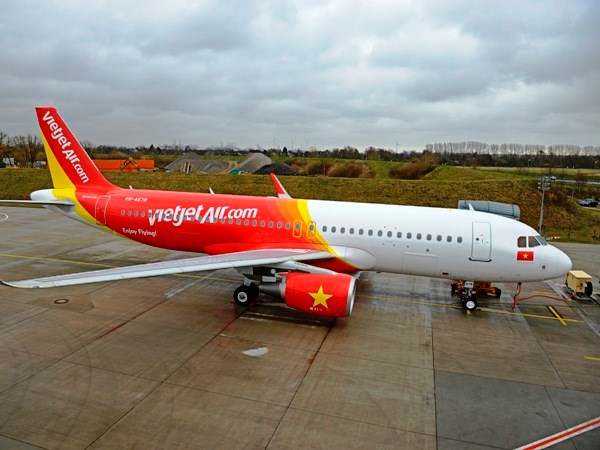
Vietnam and Russia on September 6 reached an agreement under which Russia will supply Sukhoi Superjet 100 (SSJ100) to two air transporters: Vietnam Airlines and Vietjet Air.
Deputy Industry and Trade Minister Viktor Evtukhov made the confirmation on the sidelines of the 17th session of the Vietnam-Russia Intergovernmental Committee for Economic, Commercial, Scientific, and Technological Cooperation in Vladivostok city.
Interfax quoted Evtukhov as saying Russia will “deliver the flagship of the Russian aircraft plane Sukhoi Superjet 100 to two Vietnamese airlines: Vietnam Airlines and VietJet Air”.
However, he did not disclose the number of SSJ100s and the delivery time.
“We had silence on this issue for some time, the negotiations seemed to have stalled, but today the Vietnamese side said that the interest in the liner is maintained, and we very much hope that the citizens of Vietnam will soon be able to fly on these comfortable and safe Russian aircraft,” Evtukhov said.
SSJ100 is a new aircraft family allowing its passengers to experience the mainline level of comfort. The leading-edge technologies, being the core ingredient of the Sukhoi Superjet 100 Project, penetrate its every stage – from design and development to final assembly, delivering a modern, economically efficient and globally marketable aircraft.
Sukhoi Superjet 100 features fully electronic fly-by-wire control system for piloting, landing gear extension and retraction, and a brake system to prove its high maintainability and weight perfection.
The airliner was designed and spearheaded by Sukhoi, a division of the Russian civil aerospace company (UAC), in co-operation with several foreign partners.
Source: VNN